

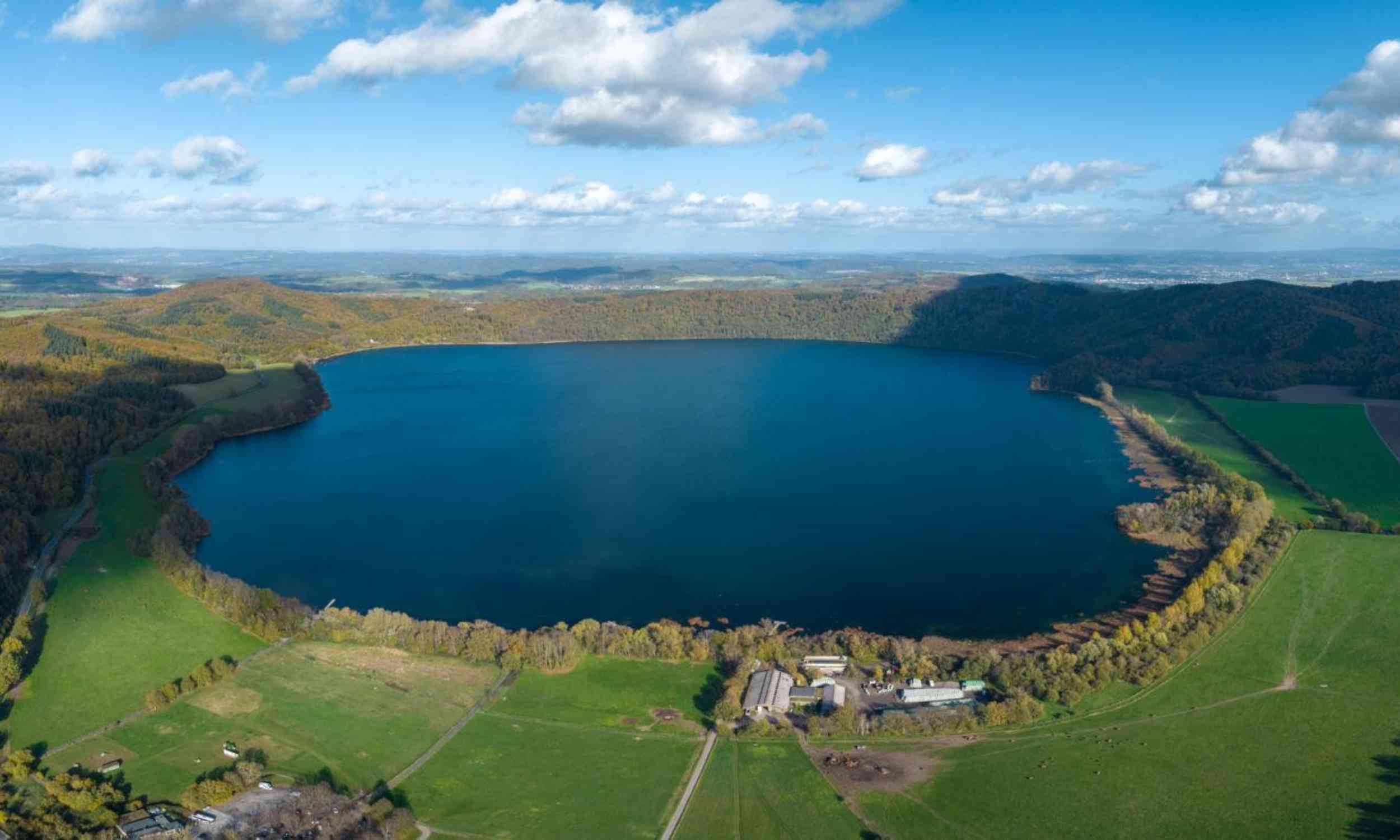

New Insights Revealed Under Germany’s Lake Laach Volcano
Recent geological studies have uncovered more than 1,000 microearthquakes, revealing a slanted reservoir beneath Germany’s Lake Laach volcano—contradicting earlier assumptions of a vertical structure. This discovery highlights a sophisticated underground system linked to the lake, suggesting an active buildup of pressure.
Unveiling the Hidden System
The evidence of these tremors emerged from a series of buried faults stretching between Ochtendung, near Koblenz, and Lake Laach, with the tremors predominantly concentrated in a narrow band. Utilizing this data, Torsten Dahm and his team at the GFZ Helmholtz Centre for Geosciences constructed a new model that indicates the reservoir slopes toward the Neuwied Basin, adjacent to the Rhine River, where several microquakes have been registered.
While this updated perspective does not imply an imminent eruption, it underscores the necessity for ongoing monitoring of the region, which appears to be geologically active.
Sophisticated Monitoring Techniques
To gain deeper insights, the research team deployed over 500 seismic sensors throughout the Eifel hills and utilized a 40-mile (64-kilometer) fiber-optic cable. This fiber-optic system detects subtle changes in light transmission caused by tiny strains and temperature fluctuations, enabling researchers to capture vibrations overlooked by conventional networks. The close positioning of these sensors—sometimes as near as one mile (1.6 kilometers) apart—has provided an unprecedented view of the underground structures.
Microearthquake Analysis
During the monitoring period, the team recorded 1,043 microearthquakes, primarily occurring between depths of 6 to 10 miles (10 to 16 kilometers). Many events manifested in rapid sequences, indicating that they likely originated from the same stressed fault zones. This pattern suggests the influence of fluid movements causing shifts in the rock, ultimately facilitating fault slips. However, in some areas, the earthquake sequences resembled typical aftershock patterns, indicating a complexity in the underlying geological dynamics.
Possible Magmatic Activity
Anomalies in seismic data signify the presence of magmatic fluids—hot gases and liquids residing between rock layers—beneath the basin. As Dahm noted, “The strength of the reflections indicates that fluids have accumulated in these layers. Whether these are magma or magmatic fluids has not yet been clarified and will be further investigated.” This distinction is crucial for assessing potential hazards, as each type of material—magma, gas, or water—behaves differently under pressure.
Historical Context and Future Implications
Lake Laach erupted approximately 13,006 years ago, marking one of Europe’s most significant volcanic events during the late Ice Age. Since 2013, increasing seismic activity at depths ranging from 6 to 25 miles (10 to 40 kilometers) below the surface has suggested that new materials are continuing to rise in the region. Gas analyses from local mineral springs also indicated persistent pulses from deep sources, reinforcing the idea of an active subsurface system.
A New Geological Framework
Prior imaging had hinted at an unusual cylindrical rock formation beneath the volcano, descending roughly 7 miles (11 kilometers). The latest seismic data enhances this imagery, depicting stress changes around the reservoir, suggesting that its active portions are situated about 5 to 6 miles (8 to 10 kilometers) deep and tilted toward the Neuwied Basin. This tilt may explain the clustering of earthquakes on one side rather than evenly around the lake.
Understanding Volcanic Hazards
The Eifel region is characterized by a distributed volcanic field with numerous ancient vents, indicating that a future eruption could occur at any of these sites, not necessarily along familiar pathways. The refined seismic maps will assist in gas monitoring, earthquake tracking, and land-use planning in this geologically intricate landscape.
Ongoing Research Needs
Despite the advancements in understanding the Lake Laach system, it is essential to note that the findings do not definitively establish an overpressurized reservoir; rather, the observed earthquake patterns align with that hypothesis. Existing weaknesses in the crust could influence seismic activity independently of a growing magma chamber. Future studies will be necessary for clearer distinctions between these possibilities.
Conclusion: A New Baseline for Eifel Volcanism
The findings indicate that Germany’s most renowned dormant volcano exhibits signs of geological activity that warrant close observation. The comprehensive data collected provides a sharper baseline for assessing future unrest in the Eifel region, as showcased in the study published in the Geophysical Journal International.
For further updates, readers are encouraged to subscribe to our newsletter for exclusive insights and articles. Explore more on EarthSnap, an app developed by Eric Ralls and Earth.com.
Source: Original Source
