


Breakthrough in Cosmic Exploration: Largest Radio Sky Survey Unveils Millions of Celestial Objects
Recent advancements in astronomical observation have dramatically altered our understanding of the universe. A significant milestone has been achieved with the release of the third data set from the LOFAR Two-metre Sky Survey (LoTSS-DR3), which uncovers nearly 13.7 million celestial entities previously invisible to the naked eye.
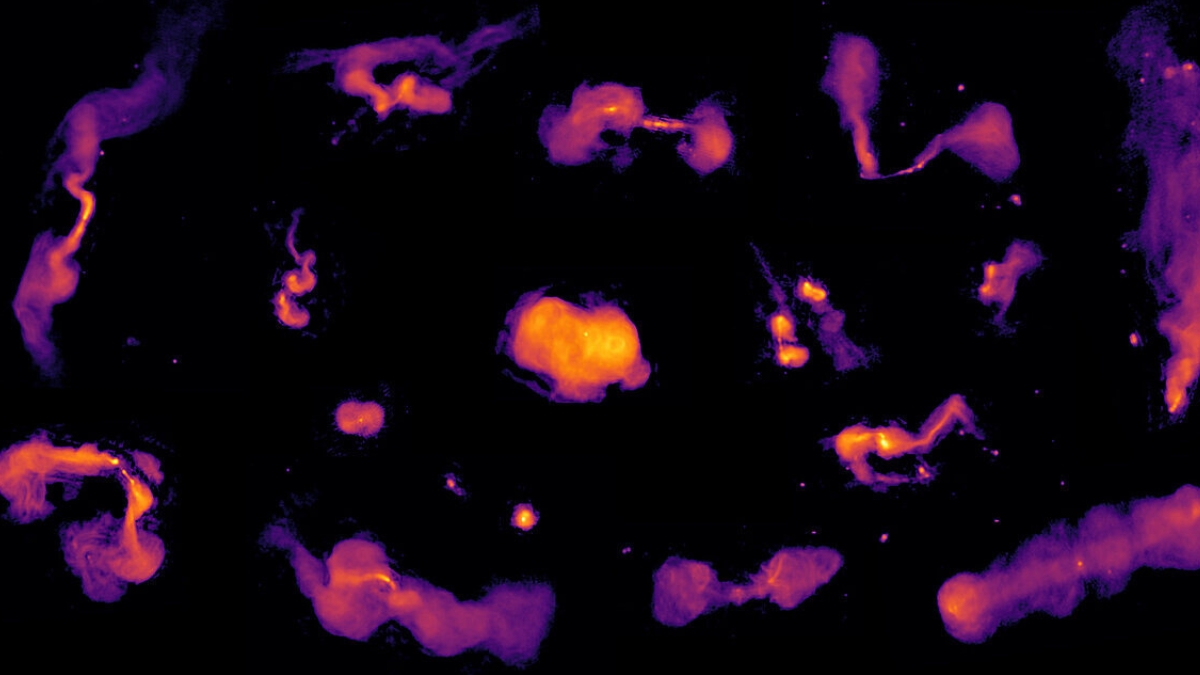
This latest data release presents an extensive collection of cosmic objects that emit radio waves, including some of the most extreme phenomena observed in the universe—such as galaxies influenced by beams from supermassive black holes, which distort their shapes in extraordinary ways.
Covering 88% of the northern sky, the survey compiles about 13,000 hours of observations gathered over several years. Timothy Shimwell, the study’s lead author and an astronomer at ASTRON and Leiden University in the Netherlands, stated, “This data release encapsulates over a decade of observations, extensive data processing, and thorough analysis conducted by an international research team.”
Details of the study were published in the journal Astronomy & Astrophysics. Utilizing the LOw Frequency ARray (LOFAR) for this survey marks a notable achievement in radio astronomy. Unlike large dish observatories typically pronounced in media, LOFAR consists of an interferometer made up of approximately 20,000 antennas distributed across 52 stations—38 located in the Netherlands and 14 in other European nations. Together, these elements extend across more than 1,000 kilometers (600 miles) and can operate as a single, unified telescope.
Alexander Drabent, an astronomer at the Thuringian State Observatory and one of the study’s co-authors, discussed the data management complexities: “The volume of data we handled—totaling 18.6 petabytes—was enormous, necessitating continuous processing and monitoring over many years, utilizing more than 20 million core hours of computing time.”
The team employed one of Europe’s leading supercomputers located at the Jülich Supercomputing Centre (JSC) in Germany to perform the necessary data analysis. “For this sky survey, it was the first time that such substantial data had to be stored, processed, and made accessible as part of an astronomical observation project,” noted Cristina Manzano, head of technical services at JSC and a co-author of the paper.
Interestingly, LOFAR does not produce traditional images; instead, creating a singular image involves amalgamating inputs from 70,000 antennas, necessitating the digitization and transportation of 13 terabits of raw data each second—equivalent to the storage capacity of over 300 DVDs.
These efforts yield strikingly unusual views of the universe. For example, LOFAR has rendered the Andromeda Galaxy into what appears as a ghostly sentinel, foreshadowing its eventual collision with our own Milky Way.
Radio emissions captured in this survey can unveil a wealth of phenomena, including exoplanets, galactic collisions, and supernova-generated magnetic fields that accelerate particles with energies surpassing those found in Earth’s largest particle accelerators.
Additionally, low-frequency radio waves can pierce through dense cosmic dust, allowing astronomers to better understand the influence of black holes on cosmic evolution and the life cycles of young stars.
With the recent data now publicly available, a surge of new studies is anticipated, following the precedent set by previous LOFAR data releases. One remarkable image, for instance, depicts 25,000 supermassive black holes.
LOFAR’s success sets a strong foundation for future endeavors, particularly the upcoming Square Kilometre Array Observatory (SKAO)—a global initiative to construct the world’s largest telescope arrays in South Africa and Australia.
The unfolding developments signal an exciting era for scientific exploration, offering the public access to groundbreaking discoveries with minimal effort—beyond navigating the wealth of information online.
This study can be accessed in full in Astronomy & Astrophysics.
Source: Original Source
