

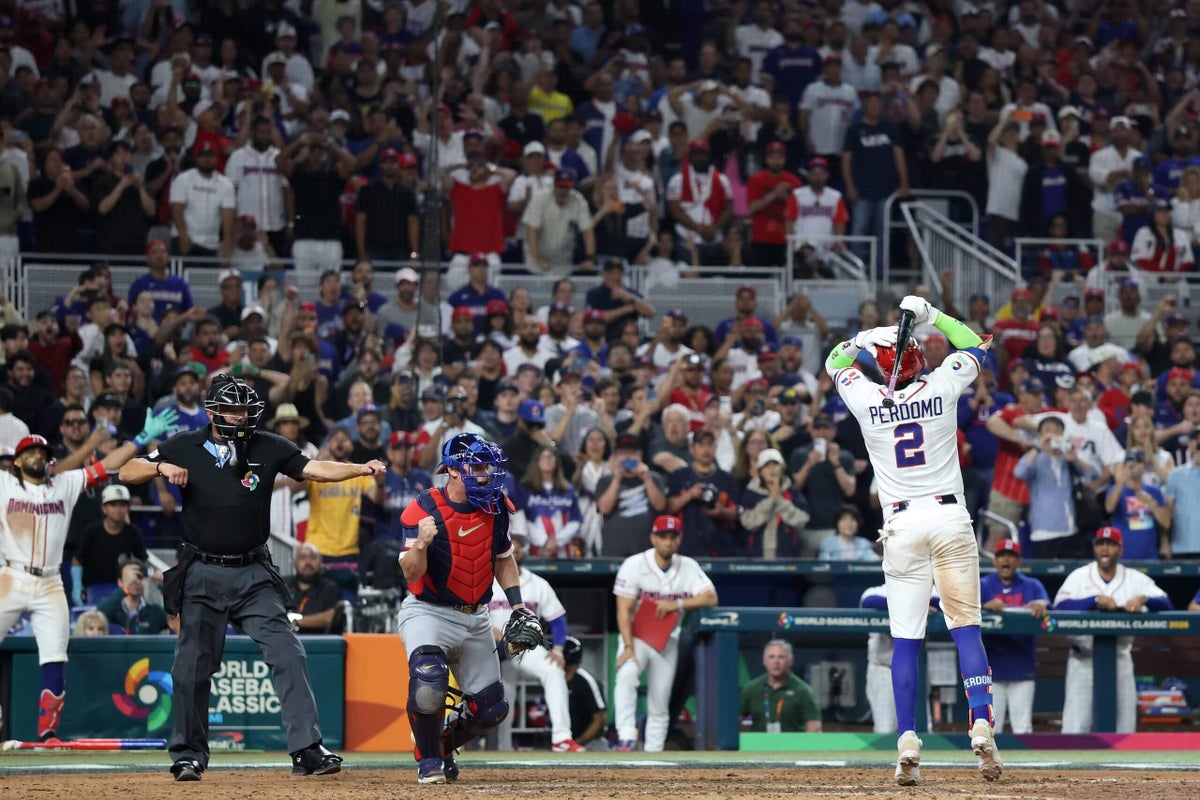

Blown Calls Mark Dramatic WBC Semifinal as U.S. Edges Dominican Republic
MIAMI — In a gripping World Baseball Classic (WBC) semifinal match, the United States secured a narrow 2-1 victory over the Dominican Republic, but not without controversy stemming from significant officiating errors.
Two pivotal strike-three calls, particularly the last one, raised eyebrows and left fans questioning the use of technology in an event of such importance. The decisive moment came when U.S. pitcher Mason Miller delivered a slider to Geraldo Perdomo that clearly fell below the strike zone but was nevertheless ruled a strike. This call effectively eliminated the Dominican Republic from the tournament, following a lengthy eight-pitch at-bat where Perdomo had already fouled off two fastballs exceeding 100 mph.
Earlier in the game, star slugger Juan Soto faced a similar fate when home plate umpire Cory Blaser miscalled a breaking ball from Garrett Whitlock, adding to the Dominican team’s frustrations.
As discussions swirled about the absence of the automated ball-strike system (ABS), which will debut in Major League Baseball this season, the Dominican team maintained composure. “Those are things that happen,” Perdomo remarked post-game in Spanish. “Everyone’s human.”
Manager Albert Pujols echoed those sentiments, urging the team to focus beyond the final pitch. “I don’t want to dwell on the last pitch,” he stated. “It just wasn’t meant to be for us.”
In the context of MLB’s spring training, umpires have benefitted from the ability to review calls, allowing players to challenge pitches in games where stakes are lower. The implementation of ABS is designed to minimize controversial decisions during critical moments, yet it is not yet part of the WBC framework.
“I’d assume it will be included next time,” commented Team USA manager Mark DeRosa after the game. “I’m a fan of it.”
Perdomo also expressed hope that ABS would be integrated into future WBC tournaments. An MLB official, who requested anonymity, indicated that while plans for the next WBC—expected in 2029—are still in the early stages, the potential for ABS adoption is on the table, pending players’ union approval.
For Dominican fans, the disappointment was palpable, as the team had been favored to clinch the WBC title. NBA star Karl-Anthony Towns humorously remarked on the contentious final call, saying, “Hell yeah that was a ball, man! That’s some bulls—.”
Historically, new technologies introduced in MLB have appeared in the WBC after a delay. This year’s tournament did witness the implementation of a pitch clock for the first time, although it couldn’t be used in the previous WBC held in 2017 as the league did not yet employ the mechanism.
Introducing such innovations in a tournament spanning multiple countries and venues requires careful planning. This year’s WBC was held in Miami, with additional games featuring venues in Houston, San Juan, Puerto Rico, and Tokyo.
Reflecting on the controversial ending, Perdomo acknowledged the pitch’s placement. “Yeah. 100 percent,” he affirmed. “But it’s all right. You know, it’s baseball. We know we didn’t lose the game right there. That’s part of the game. I hope we do better next time.”
This report includes contributions from The Athletic’s Maria Torres.
Source: Original Source
