

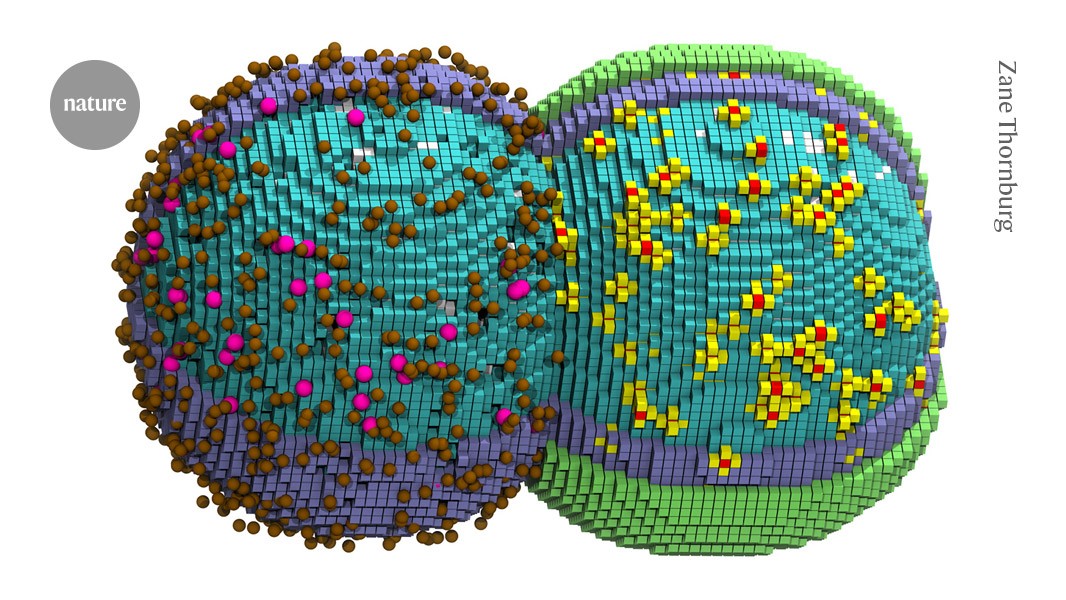

Groundbreaking Simulation Models Complete Chemical Reactions of Living Bacterial Cells
In a pioneering study, researchers have successfully simulated nearly all chemical reactions occurring within a living bacterial cell for the first time. This groundbreaking simulation illustrates the complex processes of DNA replication and cellular division.
The study, co-led by Zane Thornburg, a computational biophysicist at the University of Illinois in Urbana-Champaign, has significant implications for our understanding of how the intricate interplay of proteins, nucleic acids, lipids, and other molecules within a cell membrane contributes to the essence of life. The findings were published on March 9 in the journal Cell.
Modeling Minimal Life
Thornburg’s team focused on a simplified model of bacterial life using JCVI-Syn3a, a synthetic organism engineered by reducing the genome of the parasite Mycoplasma mycoides to just 493 essential genes, discarding over 400 non-essential ones. This minimal genome serves as an ideal basis for studying fundamental cellular processes.
The researchers created a three-dimensional simulation that mapped the dynamic interactions between the cell’s DNA, proteins, ribosomes, and various other molecular components over time. These interactions were governed by rules derived from empirical data, allowing reactions to occur when relevant biomolecules were in proximity to each other.
While aiming for accuracy, some approximations were necessary due to gaps in current scientific knowledge. For instance, several dozen genes within JCVI-Syn3a are not fully understood; therefore, the team represented these as inert spheres in the simulation. Additionally, the model restricted ribosome activity, allowing only one ribosome per mRNA transcript, rather than the multiple ribosomes typical in live cells.
Challenges and Breakthroughs
The primary objective was to accurately simulate the cell cycle duration it takes for JCVI-Syn3a to replicate its DNA and undergo division. Initial attempts were challenging, as the genome frequently disintegrated faster than it could be synthesized, or it leaked from the cell membrane.
After refining the simulation, the team allowed it to run over the Thanksgiving holiday in November. Upon returning, Thornburg recounts a moment of excitement when they discovered that an entire cell cycle had successfully progressed. “It was this huge leap,” he stated.
The simulation not only demonstrated the elongation and separation of the cell as it divided but also matched the actual time required for real cells to reproduce—105 minutes. Remarkably, this simulation required six days on a supercomputer, illustrating the substantial computational demands necessary for such intricate models.
Expert Insights
Bernhard Palsson, a bioengineer from the University of California, San Diego, emphasized the significance of the simulation, commending its comprehensive capture of cellular dynamics. “Coherently orchestrating all these processes during the cell cycle is a formidable challenge,” he noted.
The research stands as a significant advancement in computational biology, opening avenues for further exploration into the biochemical processes underpinning life itself.
Source: Original Source
