

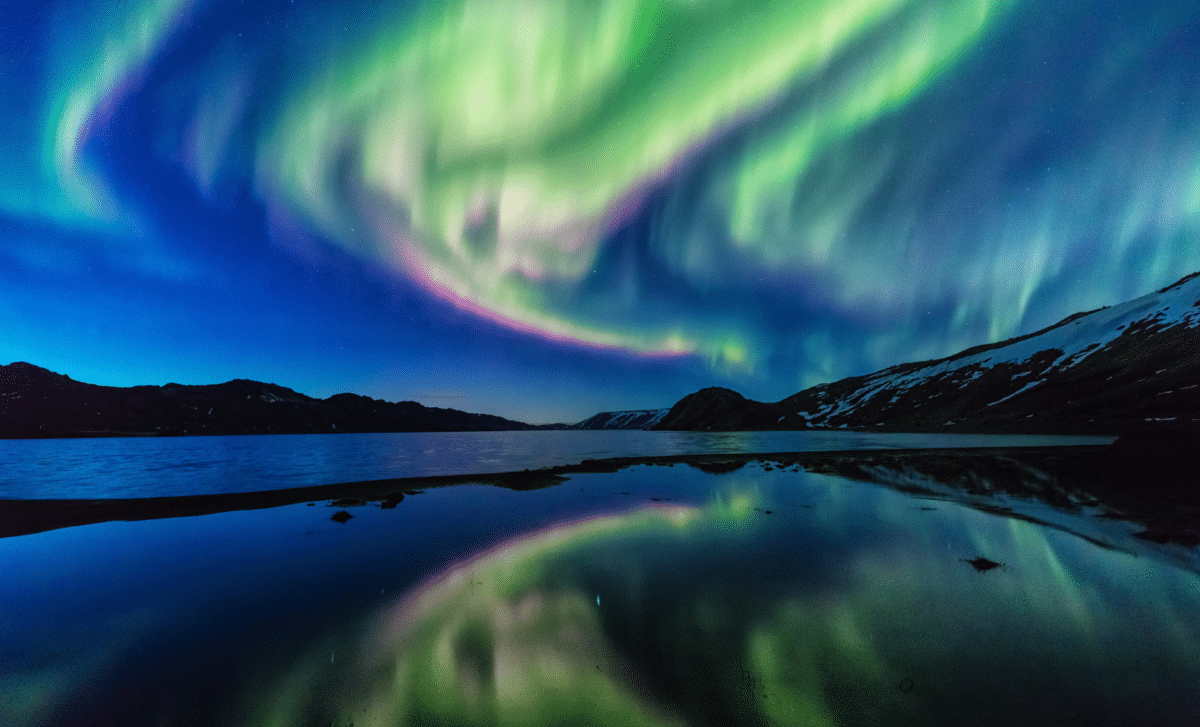

Northern Lights Set to Dazzle U.S. Skies on March 9, 2026
Tonight, March 9, 2026, stargazers in parts of the United States are poised for an exceptional celestial display, as the northern lights are forecasted to illuminate the night sky. This natural phenomenon, known as the aurora borealis, results from solar winds colliding with Earth’s magnetic field and will be most prominent in northern states such as Alaska, Washington, and Maine. According to the National Oceanic and Atmospheric Administration’s Space Weather Prediction Center (SWPC), prospective viewers in these regions will have an excellent opportunity to witness this striking spectacle, with further chances anticipated later in the month.
The Science Behind the Northern Lights
The aurora borealis is one of nature’s most captivating sights. It occurs when charged particles emitted by the sun collide with Earth’s atmosphere, creating stunning bursts of color that often manifest as vibrant green, purple, and pink waves across the sky. While these lights are typically visible near the magnetic poles, solar events occasionally push the auroras to lower latitudes.
When solar winds—comprised of fast-moving streams of charged particles—reach Earth, they interact primarily with oxygen and nitrogen present in the atmosphere. This interaction produces various colors; for example, oxygen at higher altitudes emits red and green hues, while nitrogen can generate purples, blues, and pinks.
The Impact of Solar Winds
Solar winds are crucial for determining the visibility of the northern lights. Their interaction with Earth’s magnetosphere can produce geomagnetic disturbances, enhancing the likelihood of auroras appearing even in regions farther south. The intensity and timing of these solar wind bursts are vital for predicting when and where the auroras may be observed.
Recent solar wind activity has prompted predictions of auroral displays tonight. The SWPC asserts that ongoing effects from these solar winds will likely augment geomagnetic activity, leading to visible auroras across northern parts of the United States. The organization employs a combination of satellite data and ground-based sensors to forecast the behavior of solar wind and the corresponding locations where auroras may be most prominent.

Optimal Viewing Locations for Auroras
Tonight, auroras are expected to be visible across ten states, predominantly in the northern regions. The best chances for sightings are in Alaska, Washington, Idaho, Montana, North Dakota, South Dakota, Minnesota, Wisconsin, Michigan, and Maine—areas that fall within the aurora view line.
To maximize visibility, observers should seek locations with an unobstructed view of the northern horizon, ideally away from urban light pollution. The prime viewing window for northern lights typically spans from 10 p.m. to 2 a.m. local time, though they may appear outside this timeframe. Enthusiasts are advised to allow their eyes to adjust to the darkness and use cameras to help spot faint auroras undetectable to the naked eye.
The Role of Recent Solar Activity
In addition to solar winds, a recent coronal mass ejection (CME), which occurred on March 6, could further enhance geomagnetic activity. Although it is not expected to directly impact Earth, this CME may slightly increase aurora activity, potentially leading to G1-level geomagnetic storms.
While the CME’s effect is anticipated to be mild, experts from the SWPC are closely monitoring its influence to determine if it may yield a more extensive visible range for the northern lights. Even in the absence of a direct impact from the CME, the ongoing solar winds will ensure that auroras remain visible in predicted areas tonight.
Future Opportunities for Aurora Viewing
Tonight represents one of the most promising opportunities for U.S. residents to witness the northern lights during this solar cycle. However, those unable to view this evening’s display should remain alert for additional chances, particularly as the spring equinox approaches on March 20. This period often sees enhanced aurora activity due to the alignment of Earth’s magnetic field with solar winds.
As solar activity continues to escalate, researchers at the SWPC are committed to monitoring conditions closely and providing forecasts for optimal aurora viewing moments. Enthusiasts can look forward to increasingly frequent and intense auroral displays in the years to come, ensuring more opportunities to experience this incredible natural light show.
Source: Original Source
