

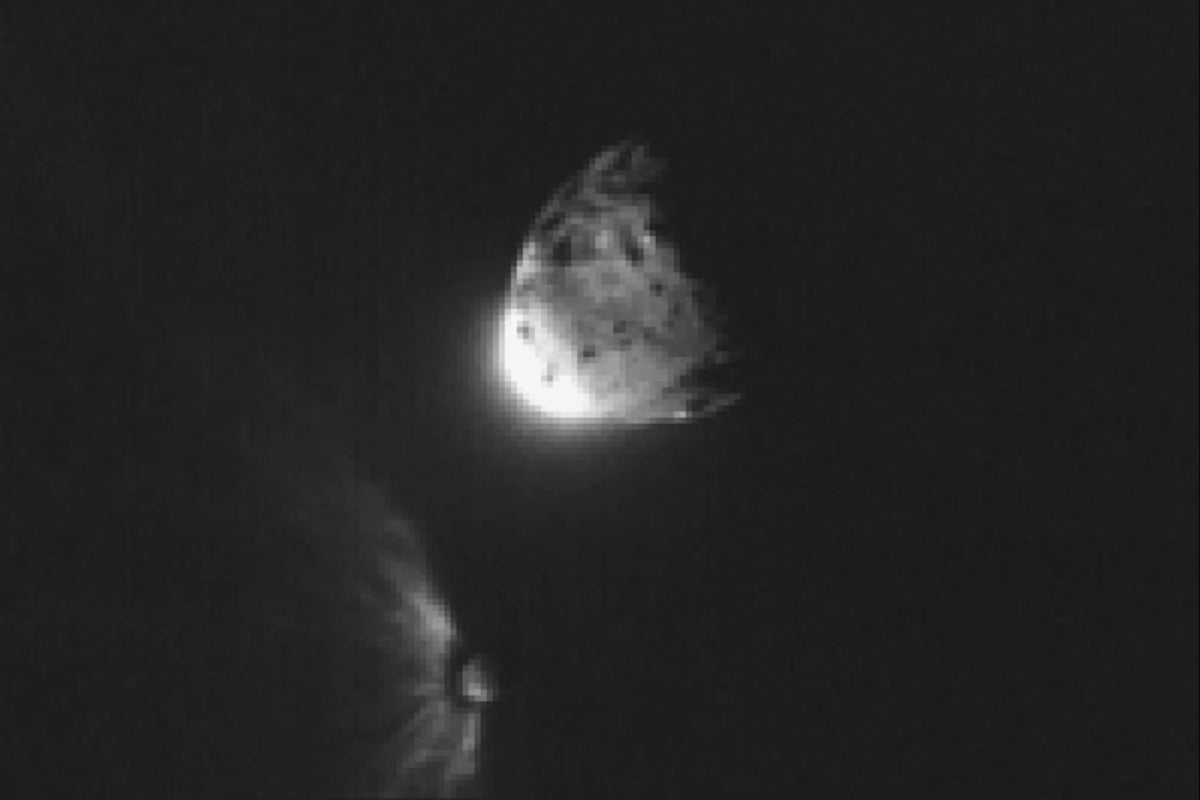

NASA’s Asteroid Deflection Test Shows Promising Results
Scientists announced on Friday that an asteroid previously targeted by NASA’s Double Asteroid Redirection Test (DART) has successfully been redirected onto a slightly altered path around the sun. This pivotal achievement could provide a framework for future efforts to divert potentially hazardous space objects.
The DART mission represents the first instance of a celestial body’s orbit being intentionally modified. Importantly, the asteroid in question, Dimorphos, posed no threat to Earth prior to the test.
Researchers published their findings in the journal Science Advances, emphasizing the significance of this breakthrough. “This study marks a notable step forward in our ability to prevent future asteroid impacts on Earth,” they stated.
The orbital adjustments were subtle, resulting in a time reduction of just one-tenth of a second and a displacement of approximately 720 meters over a solar journey lasting two years and covering vast distances. Lead author Rahil Makadia, from the University of Illinois Urbana-Champaign, commented, “Even though this seems small, a tiny deflection can accumulate over decades, significantly impacting the likelihood of a potentially hazardous asteroid hitting Earth in the future.”
He further elaborated on the strategy involved: “For effective planetary defense, the key is not delivering a substantial force at the last moment but providing a slight nudge well in advance.”
Launched in 2021 as part of the world’s first planetary defense initiative, the DART spacecraft collided with Dimorphos, which orbits the larger asteroid Didymos, as they together traverse the solar system. Subsequent evaluations confirmed that the impact decreased Dimorphos’s orbital period around Didymos.
After extensive observation, scientists verified that this impact led to a travel time reduction of 0.15 seconds in the duo’s solar orbit. Given that a complete orbit takes about 769 days, this translates to a minor but measurable slowdown of just over 10 micrometers per second, ultimately shrinking the asteroids’ orbit by 2,360 feet (720 meters).
The collision also dislodged a substantial volume of debris, effectively doubling the momentum imparted to Dimorphos. Recent estimates indicate that around 35 million pounds (16 million kilograms) of rock and dust were expelled during the impact.
Despite these changes, scientists affirm that Earth remains safely distanced from the asteroid pair for the foreseeable future, a significant factor in selecting this system for the mission, according to Steven Chesley of NASA’s Jet Propulsion Laboratory, who contributed to the study.
“While just a single experiment, this provides crucial data that will inform future asteroid deflection missions,” Chesley stated.
Further insights into the aftermath of the impact are anticipated when the European Space Agency’s Hera spacecraft arrives at the asteroids in November. Dimorphos measures 525 feet (160 meters) in diameter, while Didymos is 2,560 feet (780 meters) across and boasts approximately 200 times the mass of its smaller counterpart. Unlike DART, Hera will conduct observational studies over several months, including deploying small experimental probes intended to land on the surface.
Source: Original Source
