

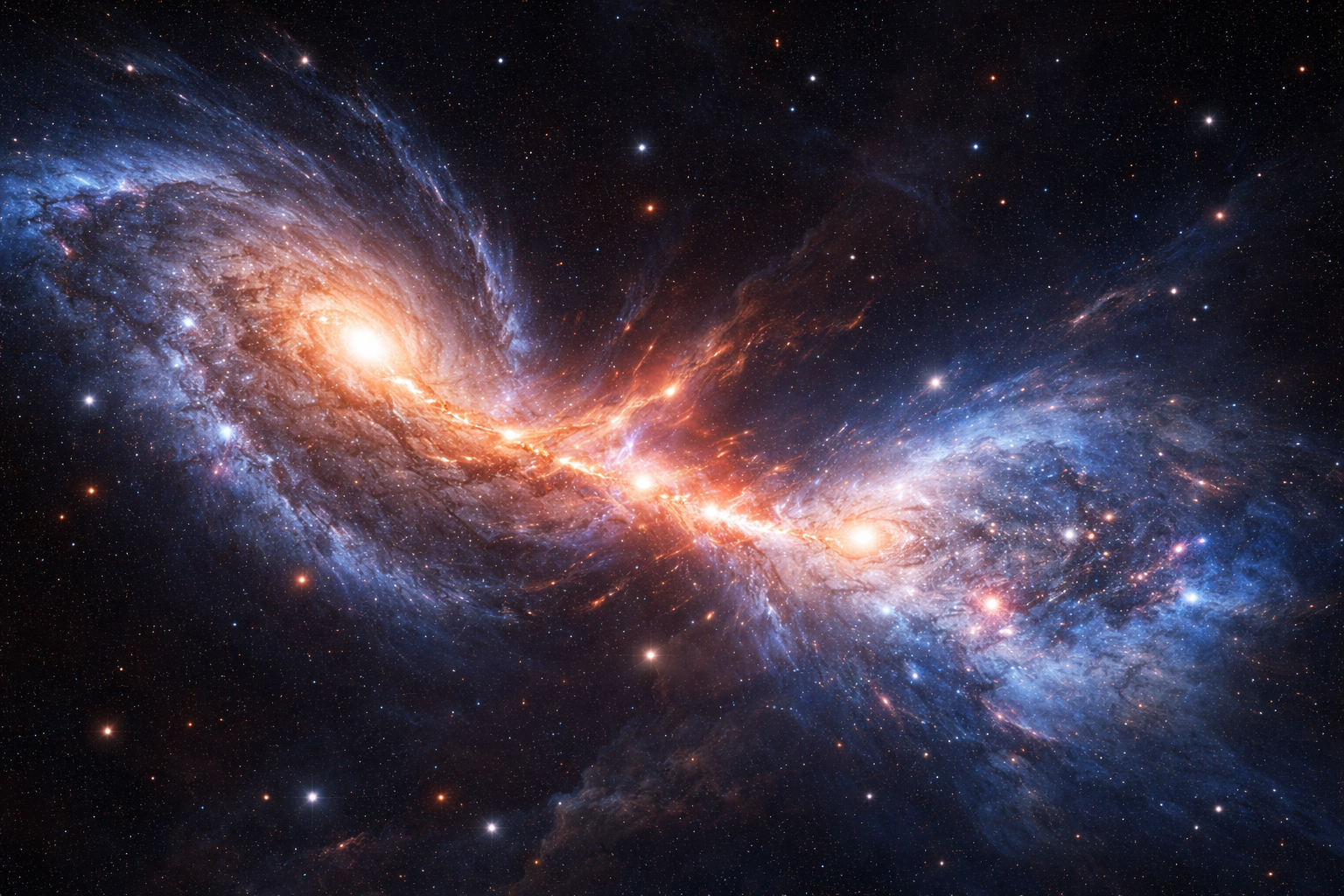

The Small Magellanic Cloud is also one of the most closely studied galaxies in the sky. Astronomers have cataloged its stars, mapped its gas, and tracked its motion for more than 50 years. Even so, one fundamental mystery has remained unsolved: why do its stars fail to orbit around the galaxy’s center the way they do in most galaxies?
Collision reveals a galaxy in transition
In a study published in The Astrophysical Journal, astronomers at the University of Arizona traced the missing stellar rotation in the Small Magellanic Cloud to a direct collision with its larger companion, the Large Magellanic Cloud. The findings also challenge the galaxy’s long-standing role as a benchmark for understanding how galaxies evolved in the early universe.
“We are seeing a galaxy transforming in live action,” said Himansh Rathore, a graduate student at Steward Observatory and lead author of the paper. “The Small Magellanic Cloud gives us a unique, front-row view of something highly transformative, a process that is critical to how galaxies evolve.”
The Small Magellanic Cloud contains more mass in gas than in stars. In most galaxies, gas cools, contracts under gravity, and settles into a rotating disk—the same basic process that shaped the spinning plane of our own solar system. But when researchers used the Hubble Space Telescope and the European Space Agency’s Gaia satellite to measure stellar motion in the SMC, they found that its stars were not orbiting the galaxy’s center in the usual way.
According to Rathore, the most likely explanation is a past collision. A few hundred million years ago, the Small Magellanic Cloud appears to have passed directly through the disk of the Large Magellanic Cloud. The LMC’s gravity disrupted the SMC’s internal structure and scattered its stars into random, disordered motion. At the same time, gas in the LMC exerted intense pressure on the SMC’s gas, destroying its rotation as well.
Rathore compared the effect to droplets of water on a hand moving through the air: the force of the air strips the droplets away. A similar pressure-driven effect, he explained, likely acted on the gas of the Small Magellanic Cloud as it plowed through the LMC.
Untangling gas motion and star formation
The collision may also solve a decades-old puzzle involving gas inside the Small Magellanic Cloud, said Gurtina Besla, an astronomy professor at Steward Observatory and senior author of the study.
For years, telescope observations suggested that gas in the SMC was rotating. But because stars form out of gas and typically inherit its motion, rotating gas should produce rotating stars as well. The new study shows that this apparent gas rotation was likely an observational illusion caused by viewing angle. As the collision stretches the Small Magellanic Cloud, gas moving toward and away from Earth along that stretched structure can appear to rotate when seen from certain perspectives.
That changes how astronomers interpret the galaxy. For decades, the Small Magellanic Cloud served as a standard reference for studying star formation and galaxy evolution across cosmic time. This new work suggests it may not be a normal or stable example after all.
“The SMC went through a catastrophic crash that injected a lot of energy into the system. It is not a ‘normal’ galaxy by any means,” Besla said.
Why the SMC may no longer be a cosmic benchmark
To reach their conclusions, the research team used computer simulations designed to match the known properties of both the SMC and the LMC, including their gas content, stellar mass, and positions relative to the Milky Way. They combined these simulations with theoretical calculations showing how the gas in the Small Magellanic Cloud would have behaved while moving through the denser gaseous environment of the LMC during the collision.
The researchers also developed new methods to interpret the scrambled stellar motions left behind in a post-collision galaxy.

These tools could now help astronomers more accurately understand what telescopes are measuring in the Small Magellanic Cloud.
That matters because the Small Magellanic Cloud is small, gas-rich, and low in heavy elements—qualities that made it a valuable stand-in for the kinds of galaxies that existed early in the universe. But if the galaxy is still recovering from a violent collision, it may no longer be a clean model for cosmic comparison.
A separate study published by the same team in 2025 found that the collision also left a visible mark on the Large Magellanic Cloud, with possible implications for dark matter research. The LMC contains a central bar-shaped structure that appears tilted out of the galaxy’s plane because of the impact. According to Rathore, the degree of that tilt may depend on how much dark matter the Small Magellanic Cloud contains, offering astronomers a new way to investigate a substance that has never been directly detected, only inferred through gravity.
“We are used to thinking of astronomy as a snapshot in time,” Rathore said. “But these two galaxies have come very close together, gone right through one another, and transformed into something different.”
Source: Original Source
