


“Project Hail Mary” Review: A Cosmic Adventure with Uneven Execution
Clichés often permeate film criticism, and one phrase I have vowed to steer clear of is labeling a film as “the movie we need right now.” Yet, it’s difficult to resist this sentiment in discussing “Project Hail Mary.” This cosmic adventure ostensibly aims to deliver a message of hope and unity at a time when it feels most needed.
Starring Ryan Gosling as Ryland Grace, a hapless science teacher enlisted to avert an environmental catastrophe, the film offers a grand scale, intertwining elements of both a sci-fi thriller and a heartfelt buddy narrative. Directed by Phil Lord and Christopher Miller—known for their work on “The Lego Movie”—the film is visually striking and filled with a sense of wonder akin to hits like “Gravity” and “The Martian.” The story, adapted from Andy Weir’s novel, sees Grace navigating a perilous universe alongside an alien companion, echoing the spirit of “E.T. the Extra-Terrestrial.”
However, despite its ambitious scope, the film falls short of being the exceptional cinematic experience it aspires to be. Clocking in at an extensive two hours and 36 minutes, “Project Hail Mary” suffers from pacing issues, feeling overly long and repetitious. A storyline reminiscent of “Interstellar,” where space travel symbolizes humanity’s last hope, lacks originality and innovation.
The relationship between Grace and the alien, nicknamed Rocky, leans heavily on familiar tropes, particularly in their communication, which initially involves mimicking body language before devolving into one-liners that resemble sitcom humor. The film’s attempts to elicit emotional responses through affectionate gestures become burdensome, detracting from its overall narrative.
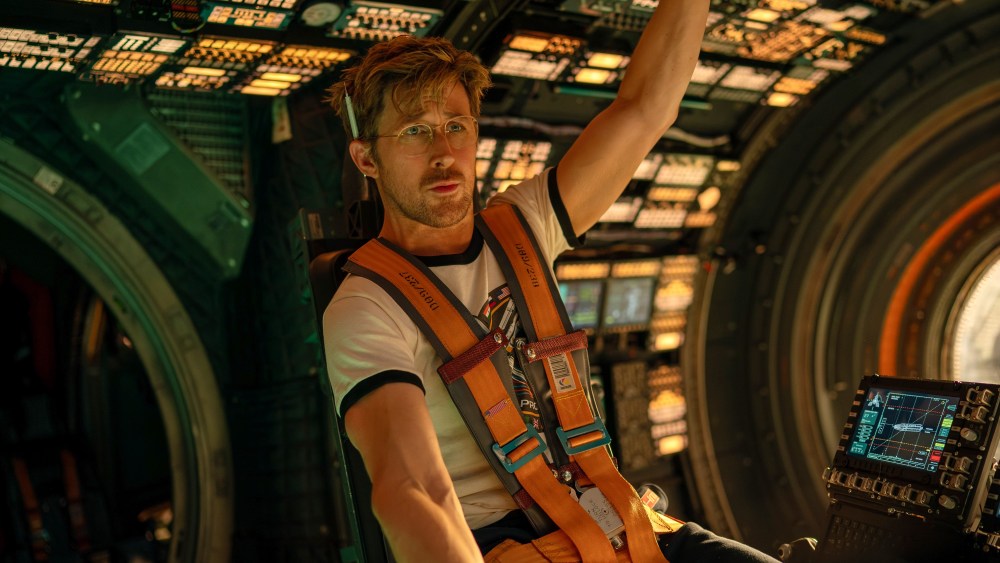
The film opens with Grace awakening in a spaceship, having been in an induced coma for decades. As he grapples with memory loss and the deaths of his fellow crew members, flashbacks reveal his character’s evolution on Earth, where he is portrayed as an eccentric yet brilliant scientist underestimated by authorities. Escaping the confines of his earlier failures, Grace is ultimately recruited to lead the Hail Mary project after his controversial theories about solar energy are validated. His journey to Tau Ceti hinges on the discovery of single-celled organisms that can serve as rocket fuel, a plot device that feels overly contrived.
Gosling’s performance brings charm to the Earth segments, capturing Grace’s anxious brilliance effectively. However, once aboard the spacecraft, that complexity diminishes; he morphs into a conventional hero archetype without the compelling neuroticism that initially defined him. The screenplay, crafted by Drew Goddard, allows for scenes that feel unnecessary, such as an abrupt karaoke interlude.
While “Project Hail Mary” aims for a climactic moment of dramatic tension around the ethical dilemma of sacrificing oneself versus saving a friend, it ultimately culminates in a predictable conclusion. Despite its glossy presentation and the potential for resonant themes, the film may resonate more as a commercial success than a profound narrative worthy of its lofty ambitions. As for the film we truly need right now? Perhaps it is one that delves deeper into the complexities of human emotion rather than focusing solely on formulaic appeal.
Source: Original Source
