

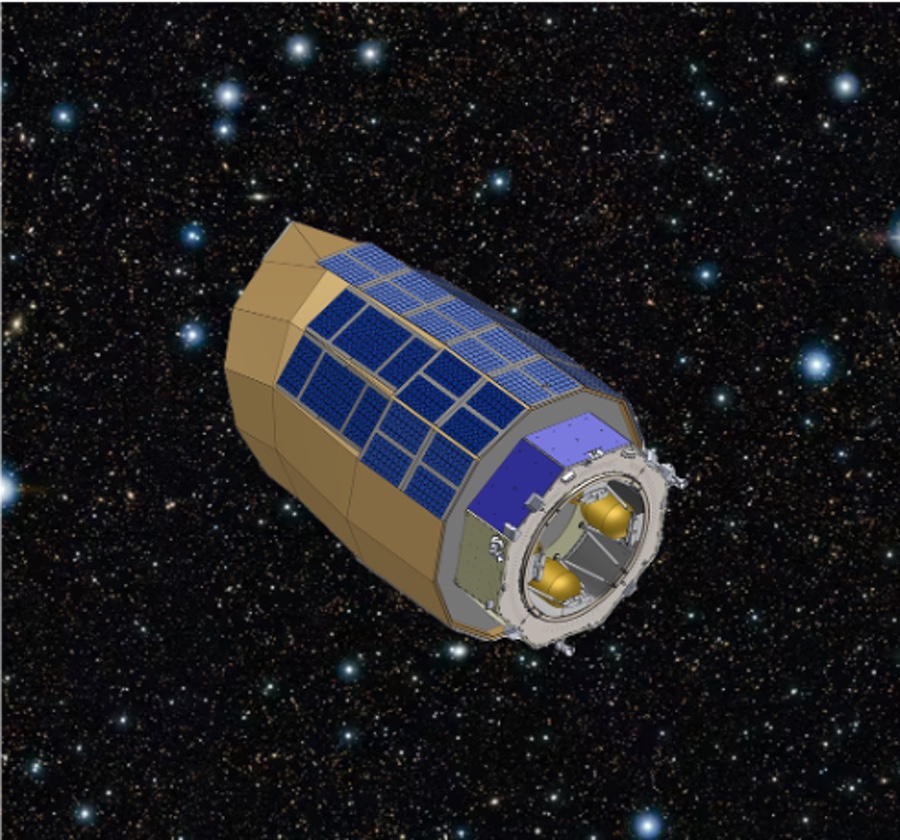

SSTL Collaborates with Schmidt Sciences on Groundbreaking Space Telescope Project
Washington, D.C. — Surrey Satellite Technology Ltd. (SSTL), a prominent British firm renowned for its expertise in small satellite development, has been selected to play a pivotal role in the construction of a large-scale, privately funded space telescope known as Lazuli.
On March 9, SSTL announced its partnership with Schmidt Sciences, the organization founded by former Google CEO Eric Schmidt and his spouse, Wendy Schmidt. SSTL will provide the spacecraft platform for Lazuli, which boasts a primary mirror exceeding the size of that of the Hubble Space Telescope. This platform will be integral to the telescope’s attitude control, propulsion, and communication systems.
Lazuli is part of the broader Eric and Wendy Schmidt Observatory System, which includes three terrestrial observatories. This ambitious project, set to launch as early as mid-2028, will feature a primary mirror measuring three meters in diameter.
The announcement of Lazuli occurred during a meeting of the American Astronomical Society in Phoenix, Arizona, where Schmidt Sciences officials revealed their partnerships with key vendors for essential spacecraft components, although they refrained from naming the involved companies.
Having been established for four decades, SSTL has distinguished itself as an early innovator in the field of small satellites, during a period when most aerospace firms focused on larger spacecraft projects. With over 70 satellites developed for various applications, including Earth observation and communications, SSTL aims to leverage its innovative methodologies in the development of large spacecraft.
Andrew Cawthorne, Managing Director of SSTL, emphasized the company’s philosophy, stating, “While SSTL is known for small satellites, ‘small’ has always described our approach, not the size of the satellite.” He further noted that Lazuli demonstrates how the principles of rapid development, practical engineering solutions, and the strategic reuse of commercial, proven technologies can be effectively applied to larger and more ambitious endeavors, including deep-space observatories.
As part of its development strategy, Schmidt Sciences plans to expedite the assembly of the spacecraft in proximity to its launch site in Florida, utilizing off-the-shelf components with a proven track record in spaceflight. Although specific details regarding other companies involved in the Lazuli mission remain undisclosed, a presentation during the project announcement indicated that the telescope will be launched from a Cape Canaveral pad currently operated by Relativity Space, a company led by Eric Schmidt.
While SSTL has not disclosed the monetary value of its contract with Schmidt Sciences, it was previously announced that the overall mission is projected to cost hundreds of millions of dollars—significantly less than a standard NASA flagship astrophysics mission.
As developments unfold, the Lazuli project stands to make notable contributions to the field of astronomical research.
Source: Original Source
